
Edward H Thompson Watercolours
scroll down for our ranges

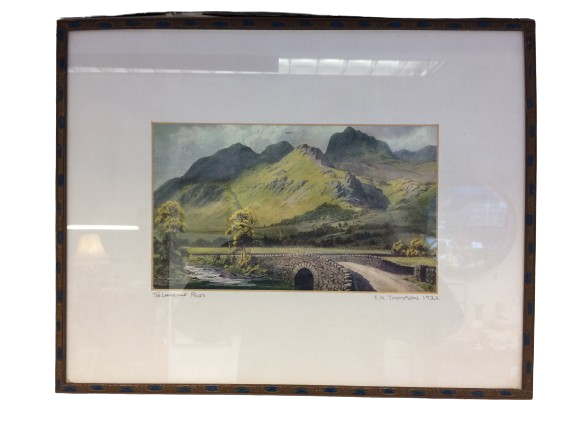
E H Thompson Print
Crummock Water ,Buttermere with a Thompson Tree 1926
SOLD
£28
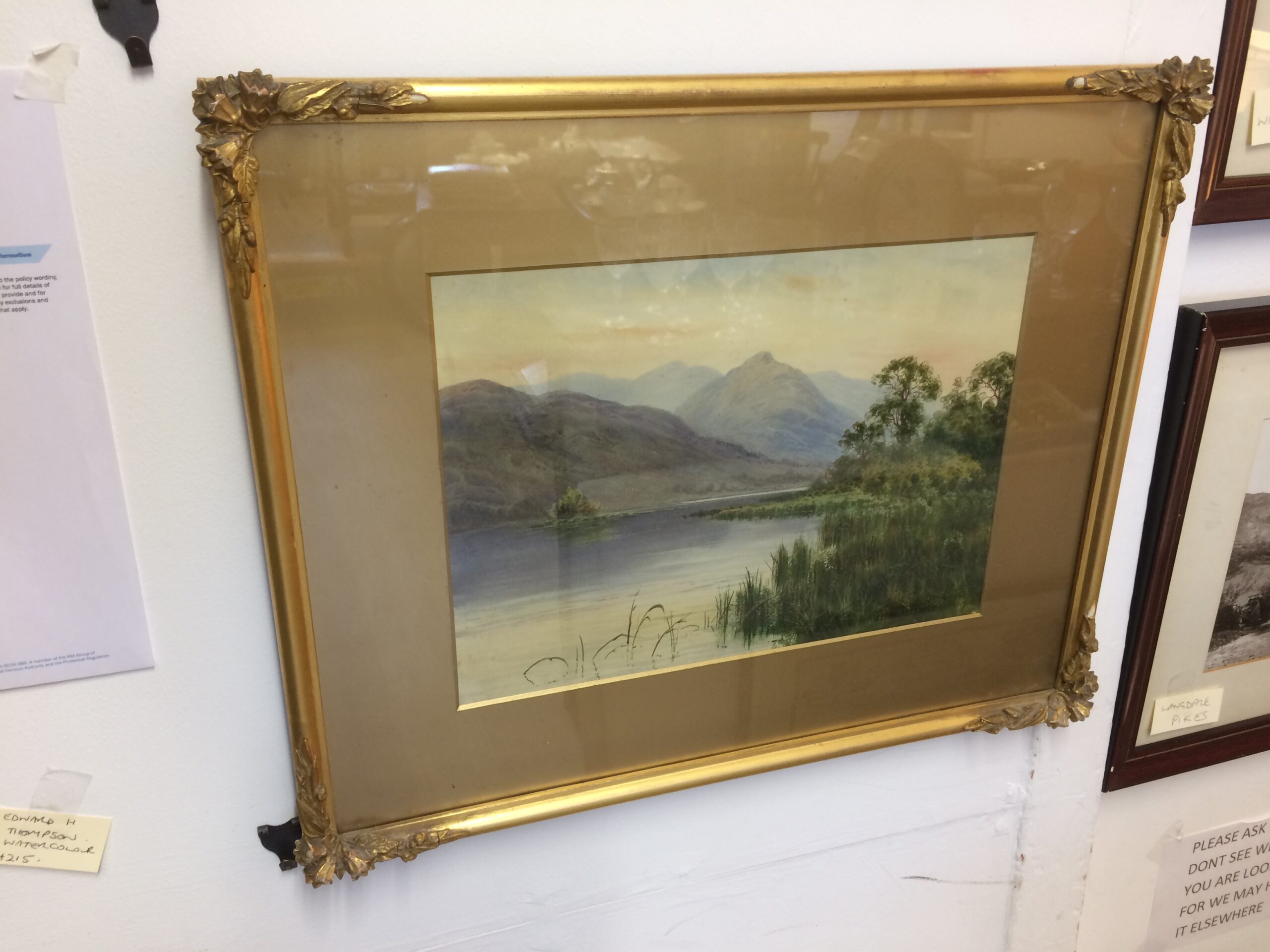
Edward H Thompson Original Watercolour Grasmere And Helm Crag Lake District 1923
£650

When Colin W. Richardson first discovered the artwork of Cumbrian artist Edward Thompson, he was unable to find any biographical details about the artist or his work. As a result, he decided to create a book that gathered memories from Thompson’s family, friends, and anyone who owned one of his paintings. This book was privately published in a limited edition of 1,000 copies and, unfortunately, is now out of print.
Edward H. Thompson: A Phenomenal Talent by C.W. Richardson, 1988
Edward ThompsonThis account is of a man who produced several thousand paintings in his lifetime – possibly as many as 10,000 – and nearly all of a remarkably high quality. This man devoted his life to painting. It was fortunate that through all the ups and downs he had the support of his wife and family. It could be said that his pictures are the essence of Cumbrian painting, yet few of the thousands of tourists who now visit the area are aware of his work. However most Cumbrians with any interest in art, own, or aspire to own, one of Thompson’s luminous landscapes; and for many others Thompson’s painting reflect their pride in their country. This man had a phenomenal talent.
Edward Horace Thompson was born on the 28th January 1879 in Seaton, Workington; both he and later his children always believed that he was born in Yorkshire.
Edward, or Ted as he was known throughout his life, had two brothers and two sisters, all at least ten years older than himself. His father worked in the steelworks of Sheffield on the technical or engineering side, and was sufficiently expert at his work to be needed in the steelworks at Workington in West Cumbria in order to introduce the new Bessemer furnaces for making steel. The family settled at 47 Gray St. in Workington and soon Ted started at the local school. This he attended until he was 14, in 1893.
“When he was about 12 years old and still at school he saw a man painting in his garden. He was curious to see what the man was doing and found he was painting a picture of his street. Dad said he felt he could do better himself and went back and painted a picture of his own street. That was the beginning”. Mollie Elisabeth Smith, Ted’s daughter.
SkiddawPainting began to dominate Ted’s life; he spent every spare moment painting after that. However his parents were not keen on this and so he took to hiding, and one of his favourite places was the lavatory. One of his older brothers Jack eventually found him there and taking Ted’s side sorted the whole thing out with their parents. From then on Ted was allowed to paint and remembered with gratitude the encouragement of his brother. But Ted’s parents still believed that being an artist was too risky a life and wanted him to have a trade or profession. They thought his interest in art was because he was too lazy and not prepared to do proper work.
About this time Ted’s talent in drawing and painting was encouraged by an art teacher, Mr. Joe Barnes (possibly Joseph Barnes a professional artist, AR Cam A 1835-1915, who was living near Keswick). Mr. Barnes was well travelled and had wide experience in the art world and he would have been able to give the young Ted the good grounding in the basic materials and techniques of his profession which Ted certainly acquired from somewhere.
When he left school Ted took a job in the “Combine” in Workington – the local name for what was to become Workington Iron and Steel Company in 1909. However Ted did not follow his father into the engineering side but went to train as a clerk in the offices where he worked for the next 25 years and painting in his spare time.
He was then living an unexceptional life. He was of robust health and build, about 5ft. 8in. tall and good looking. At the age of 23 in 1902 he married Sarah Mary Armstrong (born 9th January 1879) at St Michael’s Church, Workington. She was the daughter of Mary Elisabeth (nee Charters) and John Armstrong of Workington and formerly of The Close, Embleton near Cockermouth. She was always known as Sally.
The subjects for Ted’s paintings in the early years were of greater variety compared to those later on. As well as Lake District scenes he painted more general landscapes, though not often with buildings or people, and seascapes of beaches waves and cliffs. He apparently never included ships.
“Some of dad’s early pictures were in oils. He did a lot of seascapes and I saw these. I had an aunt who possessed some of the seascapes and I saw these. He seemed to like rough seas and cliffs and seabirds. They were very realistic to my eyes.” Mollie Elisabeth Smith, Ted’s daughter.
Ted and Sally had been married nearly seven years before their first child Dorothy was born at the house in Gray Street. In about 1910 Ted and family moved to their own house in Elizabeth Street, Workington. Ted was painting regularly and selling his paintings where he could, often through people at work. Sally later told her children of one occasion when they lived in Workington they had two rows of watercolours round the drawing room wall. When she came home one day she found that Ted had sold all of them when someone had called to see them. The story is that Ted became so well known for his paintings at the Combine that the then managing director, Sir John Randle of Bristowe Hill Keswick, paid £100 for a painting. This was, of course, a small fortune in those days.
Soon after, in 1912, Marjorie was born and in 1913 the family moved to 24 Mayo Street in Cockermouth. The Thompson’s only son John was born in 1914 and their third daughter Mary Elisabeth (Mollie) completed the family in 1916. Mollie arrived so suddenly that she beat the midwife, and the next door neighbour was called in to help with the delivery. Ted gave these neighbours two small watercolours as a thank you present. In fact whenever he owed money he would offer paintings instead, and if none were ready he’d dash one off to pay the debt.
A combination of his age and his work for the militarily important steelworks kept Ted at home in the First World War, but it mean an increase in his hours at work by several hours. His income from paintings meant the family were not badly off and they could afford a maid to help in the house.
Ted was already wearing the clothing that marked him out for most of the rest of his life. This was knickerbockers or riding breeches and woollen socks. Originally worn for cycling he grew to wear them most of the time. Only in old age and bad health did Ted have to revert to ordinary trousers.In 1918 Ted decided to give up work and become a full time artist. The family moved to a house called Bent Ash in a village called Eaglesfield near Cockermouth. He opened a studio in Cockermouth near to Wordsworth House and he would cycle in from home to paint or to give lessons to classes of up to ten students. The family now all called Ted “pop”, a name started by his wife and which was frequently used for the rest of his life.
Signature sig2
In the year 1924 Ted changed his signature on his paintings abruptly from a square form to a rounded form. The first instance of this was signed Edward H. Thompson but soon it was usually shortened to Ed. H. Thompson and with no date. The reason for the change in style is not apparent. Perhaps this was when he himself thought his work was of a truly professional character. Thompson now found that using the name Paton on some of his Lake District scenes increased their sale in Brash Brother’s shop in Cockermouth. Apparently the Cumbrians didn’t think a local painter could be much good.
In 1926 the family moved again, this time to Routenbeck Cottage, Routenbeck near Bassenthwaite Lake Station. Ted gave up his studio in Cockermouth and started once more working from home. He kept his contacts with Workington Steel Works making many of his sales through them. He also sold paintings through a number of inns and public houses, in particular The Pheasant Inn at Bassenthwaite Lake, The Castle Inn near Bassenthwaite village and The Globe Hotel in Cockermouth.
Ivy CottageIn 1928 the Thompsons moved for the last time. They went to Ivy Cottage in the tiny Hamlet of Ruddings in the parish of Setmurthy. Ruddings is near Ouse Bridge at the bottom end of Bassenthwaite Lake. Here in what had once been the Society of Friends’ meeting house Ted created a north-facing studio where he was to produce his most prolific and some consider his best work. From here he cycled or took the bus or train to his many selling places: Abraham’s and Mayson’s in Keswick, Mosses in Workington and Whitehaven and the pubs around the area.
To a large extent it was Sally who wanted to live at Ruddings. It was near the house where she was born and where her parents had come from. But life at Ruddings was certainly not all bliss. It appears to be an unfortunate fact of life that the most creative people have some major personality failing. Perhaps the failing is necessary if the creativity is to exist. It was possibly the numerous visits to pubs and inns that provided the temptation which found Ted Thompson’s weakness. Unfortunately many people now know only of him as a painter and a drinker.
“Those were very unhappy times for the family because we never knew where he was and if he would get home safely, and he did some very strange things but did not seem to recall them afterwards. This is a section of his life no one really likes to remember. Most people who did not really know him do tend to get it all out of proportion and I think exaggerate it ” Mollie Elisabeth Smith, Ted’s daughter.
Ted also had what is now considered another bad habit. He chain-smoked cigarettes even while working. Sally allowed him 10 Woodbines a day out of the house keeping. He then also bought Capstans from his own resources. The smoking affected his health and he knew it, but he would do nothing about it. From the age of 40 he had a smoker’s cough. In fact a local farmer when asked how he knew what time to get up without an alarm clock maintained that Ted’s first coughing spell of the day woke him up.
Derwentwater postcardAs he became more successful Valentines of Dundee, the publishers, contacted Ted. At that time they printed picture postcards and Ted painted many for them. Unfortunately Valentines have few records of Ted’s work as they gave up postcards in the 1960’s, and they gave most of their records to the library of the University of St. Andrews. It appears that Thompson started painting for Valentines in the early 1930’s. At first he painted his standard Lake District scenes, there are about 60 of these. Later he painted other places but these were based on photographs and many have stiffness about them. In the 1940’s Valentines reproduced the pictures in the form of booklets and also calendars. Ted’s last work for Valentines appears to have been a series of idealised country cottages, in 1949 for a calendar. He was paid £5 each for these (a workman’s weekly wage at the time).
A couple of paintings were sent to the Royal Academy when a visitor to an exhibition suggested he send them. He wasn’t in any societies because he did not think himself in any way outstanding.
In 1939 Mollie married and for a few years Ted and Sally lived on their own. Ted continued to take students, mainly in the winter months he would take classes but not on a grand scale and mainly for local people with a flair for painting.
Dunny the terrier was a companion to Ted throughout the thirties. But Dunny knew that a walk with Ted often finished at the Pheasant Inn and a long wait, so she would choose to go with someone else going for a walk in some other direction. Dunny lived until 1942.
Haweswater as PatonIt is well known that Thompson often used the pseudonym of Donald Paton, but what is not so well known is that in later life he signed a few paintings with the name of his late friend Donald Southern. As Southern produced many paintings himself confusion could arise from this, but the differences in style and quality are easily spotted. In Thompson’s paintings the signature for the Donald is the same as for Donald Paton and the rest the same as the curved Thompson signatures.
From about 1940 Sally was increasingly troubled by illness. She lost her voice and had a stroke. A major shock was the death of their son John in 1943. He had enlisted in the army but was killed in an accident while awaiting embarkation near Stranraer. Marjorie returned home to look after her parents and found the house run down. In the late 1940’s Ted’s sight began to fail.
In 1947 Sally died. She was buried at Setmurthy Church. Ted himself died on the 23rd December 1949 in Keswick Cottage hospital. He was 70. He had painted intermittently up to his death and there was a painting on his easel and numerous others still around his house. Despite the popularity of his paintings Ted did not rate an obituary in the local paper when he died.
Edward Thompson painted mainly in watercolours. Often he added body colour to give an opaque appearance and in fact the colours are often so thick that some people think they have an oil painting. His watercolours usually vary in size but are never less than about 6×9 inches.
For a long time Thompson drew his subject with a fairly black pencil and rubbed out the strong outline as he painted. Once he borrowed a pencil from his son-in-law, an end of a 3H pencil from work. Thompson found that with this he did not need to rub out and could save time on his pictures, so for a while Frank had to bring him his stubs of pencils.
He made full use of artistic licence in his scenes. For example, when he had done a picture he would often add a foreground tree and if he was told there was no tree there he would maintain “its been chopped down”.
Artist’s material was obtained locally from Brashes in Cockermouth or Mosses in Workington. Picture frames were mainly obtained from Preston although many of his paintings were sold unframed. During the war some materials were hard to get hold of. Thompson could not get his favourite colour cobalt blue, of which he normally used huge tubes. The greens he used then turned to blue in time and if he later could get hold of these paintings he repainted them.
With his dedication to painting Thompson had little interest in household chores. He found that bringing in the coal would make his hand shake spoiling subsequent painting. But cycling did not have this effect! His complete absorption in some scene or visual effect resulted in him falling from the bicycle into a ditch. He had to give up cycling eventually.
Was Edward Thompson a great artist? Many would claim that his work was too “chocolate box” in style. He certainly produced what people wanted and mass-produced pictures. A consequence is that one cannot find a single Thompson painting in a public art gallery and all of them are privately owned. Thompson himself believed that he had painted too many pictures ever to become significant.
Thompson paintings have a distinctive style and an inimitable nature. Hundreds of painters have tried to reproduce the Thompson look but all have failed. So perhaps Thompson may yet get some belated recognition from the establishment. He should certainly have a strong representation in the local Lakes District galleries and museums.
For more information please vist a wonderful website
Talk to us
Have any questions? We are always open to talk about your business, new projects, creative opportunities and how we can help you.